Wine Cooler Repair
Sub-Zero Wine Refrigerator Buying Guide: What to Check First
A good wine refrigerator buy comes down to four checks: the build date on its serial tag, what the model number tells you, whether every zone holds its setting, and the repair history. Here is how Bellevue buyers can run each one on a Sub-Zero or any other make.
Written by
Bjorn Aaltonen
Refrigeration technician — wine storage and dual zones · 15 years in the trade · EPA 608 certified
Treats a drifting wine zone as a question about air rather than about the compressor: damper travel first, then the fan, then the door. Logs a full day before condemning a control, because the fault is usually only present for part of it.
A sound wine refrigerator purchase rests on four checks made before you pay: the age printed on its serial tag, what the model number reveals about its line and width, whether every zone settles at the temperature you set, and a paper trail of past repairs. The same checks apply to a new unit, a showroom model or a column that conveys with a house. If the home you are buying in Somerset or Crossroads has one built into the cabinetry, treat it like the roof: it is part of the price, and replacing it later means new panels and trim.
Start with the serial tag, not the listing
Listings flatter; the serial tag does not. Sub-Zero’s manuals call it the rating plate, and it records the model number, the serial number, the date the unit was built, the refrigerant type and charge, and the total amps it draws. That build date beats a seller’s memory of when the kitchen was redone.
On DEU undercounter units the tag is fixed to the cabinet ceiling, so crouch down with a phone light. On other models it sits elsewhere inside, and that model’s use and care guide shows the spot. Photograph the whole plate; parts lookups, warranty questions and any technician will all start from it.
Decode the model number
A Sub-Zero model number reads left to right like a short spec sheet. The opening letters name the product line, the digits after them give the width, such as 18, 30 or 36, and any trailing letters describe features like the panel type or door style. The prefixes you are most likely to meet:
| Prefix | What Sub-Zero calls it |
|---|---|
| CL | Classic |
| BI, BW | Legacy Classic, sold as Built-In before the rename |
| DET, DEC | Designer |
| DEU | Designer Undercounter |
| IT, IC, ID, IW | Legacy Designer, sold as Integrated before the rename |
| UC | Undercounter |
Names shifted in March 2019. Classic replaced Built-In, Designer replaced Integrated, and PRO stayed PRO. A seller who calls a wine column Integrated is probably showing you a legacy IW unit, and the tag’s build date shows how long before the change it was made.
The line also tells you how the unit was meant to be installed. Sub-Zero steers buyers toward Classic when a unit will stand on its own or have a side partly exposed, and toward Designer when it should disappear into the cabinetry behind matching panels. A Designer unit lifted from another kitchen will need panels made for yours, a real cost on top of any used price.
Make every zone prove itself
A wine refrigerator that holds one zone and lets the other wander is not a bargain. On Designer Undercounter models the wine setting runs from 40°F to 65°F, and the 24-inch DEU2450W divides its cabinet into two separate wine zones, so your test has to cover both. If the seller allows it, set the zones a few degrees apart, stand an inexpensive thermometer in a glass of water in each one, and read them after several hours with the doors closed. A reading that strays well away from the display is the fault described in our guide to a wine zone reading several degrees off.
Watch the display as well. On a Designer Wine (IW) unit, 95 1 00 only means the zone 1 door stood open for 20 minutes or more, which is easy to trigger during an open house; clear the doorway, reset the breaker for 30 seconds and see whether it stays away. 40 1 09 is more serious: zone 1 is running far too warm or too cold, and if it comes back after that same breaker reset, the unit needs a technician before it needs a new owner.
Then listen. A gentle fan hum, a compressor cycling on and off and the odd click from the control are ordinary. Grinding, rattling or a ticking fan blade point to a motor or mounting problem. Finally, check the base for water: a damp floor usually means meltwater is missing its drain pan or a seal has given up, and neither fixes itself.
Inspect the door, the glass and the seals
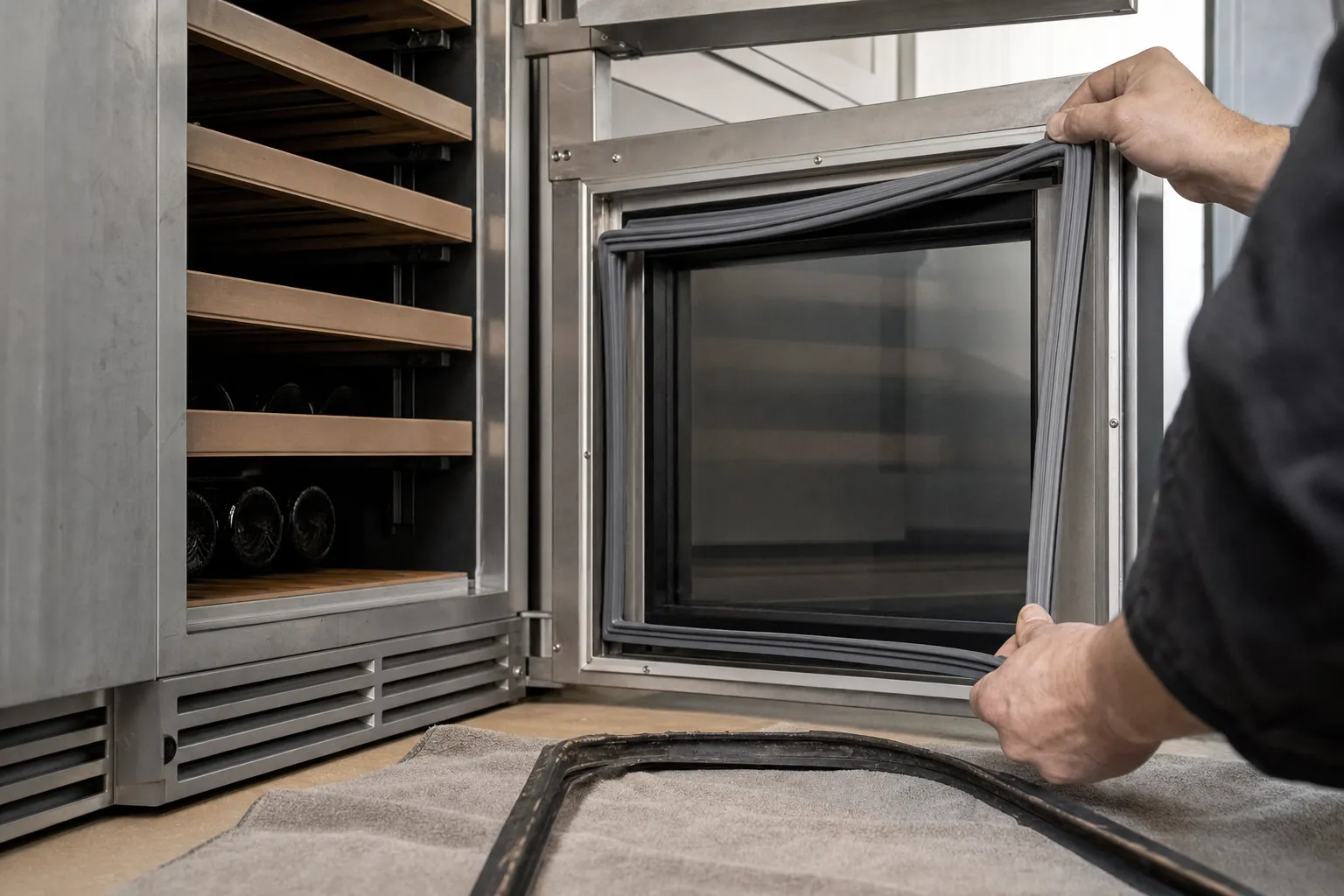
Run a hand slowly around the door gasket. It should feel soft and spring back, with no tears, flat spots or hardened corners. Next, trap a sheet of notepaper between door and frame at three or four spots, then tug each one; wherever it slides free with no resistance, that stretch of seal has gone weak. A weak seal lets humid room air in, and in a Bellevue house during a wet November that shows up as beads of water on the inside of the glass, frost on the back wall and a compressor that rarely gets a rest.
Open and close each door a few times: it should swing without sagging and meet the cabinet evenly. Slide every rack out and check the lights. To clean a unit you have just bought, warm water with a little mild dish soap and a soft cloth are enough for the gasket, the glass and the interior walls; skip abrasive pads, which scratch glass and roughen the seal.
Water, power and the room it will live in
Apart from the IW-30CI, Sub-Zero wine storage has no internal water filter, so there is no cartridge history to chase. What does matter is the room. When some Sub-Zero wine models raise a warm-cabinet alarm, EC 10 for the upper section or EC 12 for the lower, the first thing Sub-Zero asks you to confirm is a room temperature between 60°F (16°C) and 90°F (32°C). An unheated garage in Bridle Trails or anywhere else in Bellevue can sit below that for much of the winter, so a garage unit may struggle where a kitchen one would not.
Planning a covered patio? Buy a unit approved for it. Sub-Zero’s Outdoor Limited Warranty pairs one full year of parts-and-labor coverage with five full years on the sealed system, but only for products cleared for outdoor installation by model and serial number.
Floor models, invoices and service history
Showroom units can be good value if the paperwork is right. A display product sold three to seven years after its manufacturer invoice date still earns Sub-Zero coverage: one full year on the whole unit, plus a limited five years on the sealed system. None of it switches on until you produce a copy of a paid invoice, so file that invoice with your photograph of the serial tag.
For a used unit, or one that conveys with a house in Downtown Bellevue, ask for every repair receipt the owner kept. A new gasket or fan motor is routine upkeep. A replaced control board or any sealed-system work deserves follow-up questions: when it happened, why, and whether the fault has returned since.
What repairs cost if the checks turn something up
Knowing the likely bill lets you price a fault into your offer rather than walk away. The figures below are typical, and the firm quote always comes after diagnosis. A worn seal is the cheapest thing a check can turn up: fitting a new one typically costs $280–$670. When a fan is noisy or has stopped, at the evaporator or the condenser, the new motor usually comes to $330–$750 fitted. If the display misbehaves because the control itself has failed, expect a new board to cost about $400–$910. The expensive end is the compressor and the rest of the sealed system, where work typically lands at $1,400–$3,060.
Want a technician to look before you sign? Our $89 service call covers travel and a thorough diagnosis, and should you approve the fix, we deduct that $89 from what it costs. Read more about Sub-Zero wine cooler repair in Bellevue or call (425) 696-2636.
Asked after reading this
How can I tell how old a used Sub-Zero wine refrigerator is?
Read the manufacture date on the serial tag, which Sub-Zero manuals call the rating plate. On DEU undercounter units it sits on the cabinet ceiling. Photograph it before you start negotiating.
Is it normal for a wine refrigerator to make noise?
Some sound is normal: a soft fan hum, the compressor starting and stopping, and an occasional click as the control cycles. Grinding, rattling, a buzz that never settles or a fan that ticks are not normal, and deserve a diagnosis before you buy.
Why would a wine fridge leak water onto the floor?
Usually the defrost water is missing its drain pan, because a drain is blocked or the cabinet is not level, or a worn door seal is letting damp room air in to condense. Check the floor around any unit before buying.
How much is a typical wine cooler repair?
The bill follows whichever part has failed. Swapping a tired door seal typically costs $280–$670, while putting in a new fan motor usually comes to $330–$750. A dead control board tends to cost $400–$910, and the big one is the compressor or the rest of the sealed system, at $1,400–$3,060. The $89 service call pays for the trip and diagnosis and is deducted if you proceed; the firm price comes after diagnosis.
Why is my wine cooler not cooling?
Start with the simple causes: a room colder than 60°F or hotter than 90°F, a door that no longer seals, or a blocked grille starving the unit of air. If the zone stays warm or the display keeps showing a cooling fault after a 30-second breaker reset, the fan, control or sealed system needs a technician.