Wine Cooler Repair
Sub-Zero Wine Cooler Zone Reading Five Degrees Out of Range
When one zone of a dual-zone Sub-Zero wine cabinet sits several degrees off its setpoint, the control board is almost never the cause. Here is the order to check things in, and what each symptom actually points at.
Written by
Bjorn Aaltonen
Refrigeration technician — wine storage and dual zones · 15 years in the trade · EPA 608 certified
Treats a drifting wine zone as a question about air rather than about the compressor: damper travel first, then the fan, then the door. Logs a full day before condemning a control, because the fault is usually only present for part of it.
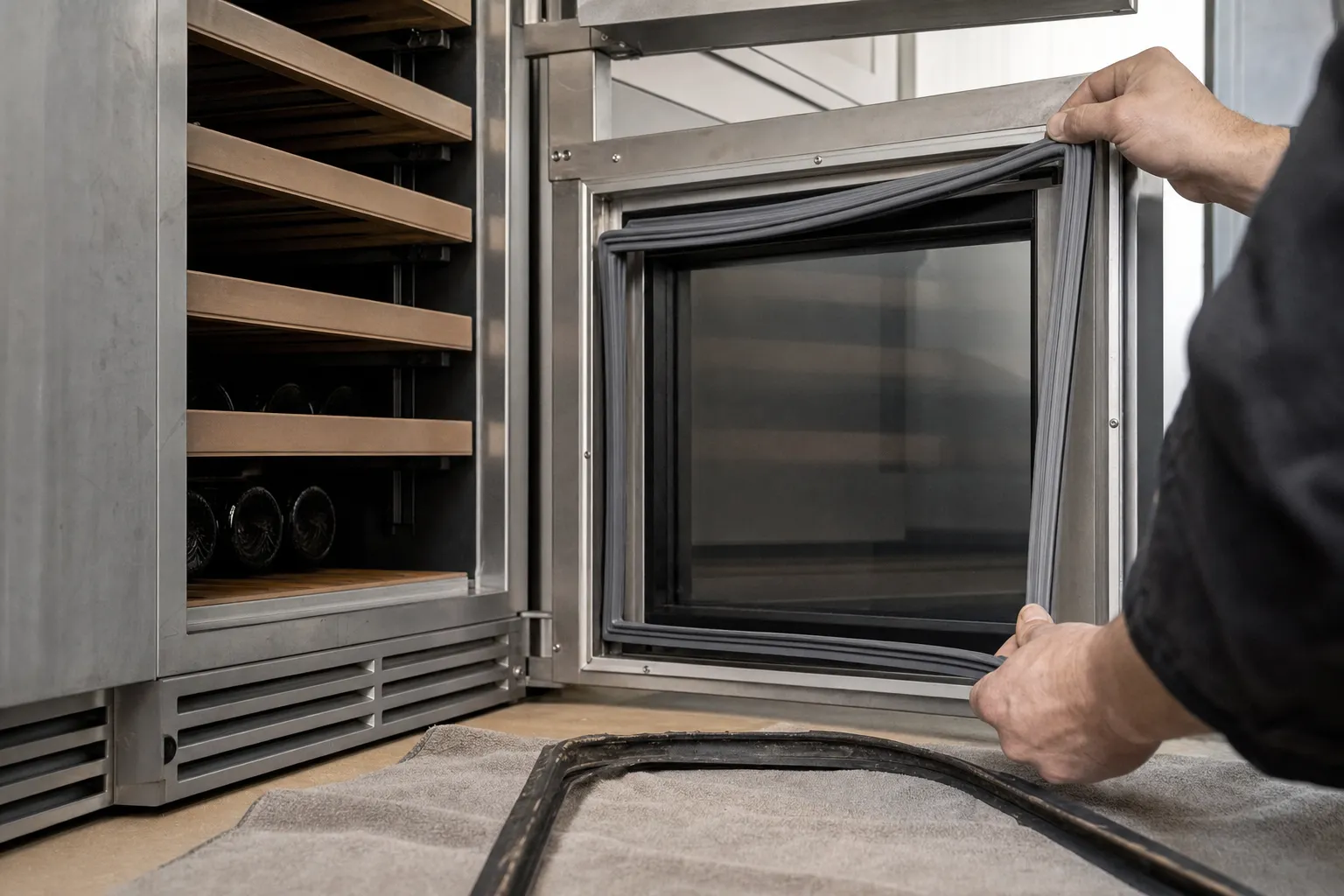
Dual-zone wine storage produces a very particular complaint: the panel says 55°F, the bottles feel warmer than that, and an independent thermometer on the shelf reads 60°F or above. It is unsettling in a way that a warm refrigerator is not, because there is no obvious failure — the unit is running, the light works, the display looks confident.
That confidence is the problem. The display reports what the sensor tells the board, and a good deal of wine-cabinet troubleshooting is really about working out whether the sensor is describing reality.
What “five degrees off” usually is
In rough order of how often we find each of them, a persistent zone drift comes down to: a door seal that has stopped sealing, a thermistor that has drifted out of calibration, an airflow path blocked by how the cabinet has been loaded, a condenser so choked with dust that the system cannot reject heat properly, or — last and least often — a control board.
Notice where the board sits on that list. It is the part most frequently replaced on these units and the part least frequently responsible. A board is an easy sale precisely because it cannot be argued with, and swapping it out looks like decisive action. It is worth insisting the cheaper causes are ruled out first.
The other thing worth establishing before anything else is what you are actually measuring. Put a decent independent thermometer on a middle shelf, not against the back wall and not in the door, and leave it for a full day. A reading taken five minutes after the door has been open tells you nothing.
Start with the seal, not the board
Wine cabinet doors work harder than refrigerator doors and get less sympathy. They are usually glass, they are heavier than they look, they are often full-height, and on a glass door the seal is fighting a much larger thermal gradient at its edge than a solid door ever does.
Run the paper test at a dozen points around the frame: close the door on a strip of paper and pull. Any point where it comes out with no resistance is a leak. Pay attention to the top corner on the handle side, which takes the most strain over a decade of opening.
Condensation is the corroborating symptom. If the interior glass fogs in the afternoon and clears in the evening, or if labels are lifting off bottles, you have humid room air entering the cabinet continuously. That is a seal or alignment problem and no amount of adjusting the setpoint will compensate for it, because the compressor is being asked to chill a slow leak of Bellevue summer air.
Alignment is the close cousin of seal failure. A cabinet that has been pulled out for cabinetry work and refitted slightly out of square will look perfect and seal badly.
Compressor and condenser: the other half
If the door is sound, the next place to look is heat rejection. A wine cabinet has to dump the heat it removes somewhere, and it does that through a condenser coil with a fan across it, usually behind a grille at the base.
Under-island and built-in installations are unforgiving here. The clearance is minimal, the grille is at floor level, and it collects dust, pet hair and kitchen grease. As the coil clogs, the system loses efficiency; the compressor runs longer and longer to hold the same temperature, and eventually it simply cannot reach setpoint on a warm afternoon. The tell is a unit that holds fine overnight and drifts in the afternoon, and a hum that has become noticeable when it never used to be.
That grille comes off. Vacuum the coil, brush it out, check the fan actually spins freely. It is a fifteen-minute job that resolves a meaningful share of drift complaints, and it is the sort of thing worth doing twice a year whether or not you have a problem.
If the coil is clean, the fan runs and the drift persists, the diagnosis moves to the sealed system and the thermistors, and that needs gauges and reference readings rather than a torch and a screwdriver.
What to check over one evening
Do these in order, and note what you find.
- Independent thermometer on a middle shelf in the drifting zone, left for twenty-four hours. Compare with the panel reading.
- Paper test around the whole door perimeter, both zones.
- Look for interior fogging in the afternoon and for lifting labels.
- Pull the base grille and check the condenser coil for dust build-up.
- Note whether the drift is constant or follows the time of day.
- Check the loading: bottles jammed against the rear wall block the air path that the zone divider depends on.
That last one matters more than people expect. Dual-zone cabinets separate their compartments partly by managed airflow, and a fully packed cabinet with bottles pressed against the rear vents will not maintain the spread it is supposed to.
When the drift is actually normal
Some of what gets reported as a fault is the cabinet working correctly.
A newly filled cabinet takes days, not hours, to settle — you have added a large thermal mass at room temperature and it has to come down slowly by design. A cabinet in an unconditioned space, a garage or a west-facing Somerset kitchen that hits the high 80s indoors in August, is being asked to work outside its rated ambient range and will drift on the hottest afternoons regardless of its condition. And a couple of degrees of swing across a compressor cycle is not drift at all; it is how a thermostat works.
The line worth drawing is between variation and trend. Variation around a stable average is fine. A number that has moved and stayed moved, or one that keeps climbing through the season, is a fault — and on the evidence of the cabinets we open in Bellevue, it is a seal or a dirty condenser far more often than it is electronics.
Asked after reading this
How much variation is acceptable in a wine cabinet?
A degree or two of swing through the compressor cycle is normal and harmless — wine responds to sustained averages, not to short excursions. Persistent drift of four or five degrees from setpoint, or a slow seasonal creep, is a fault worth chasing.
Does the upper zone always run warmer?
Yes, by design. In a dual-zone cabinet the upper compartment is intended for reds and the lower for whites and sparkling, so a genuine spread between them is expected. The question is whether the spread matches what you set, not whether a spread exists.
Should I move the bottles while it is being diagnosed?
Usually not. A cabinet holding steadily at the wrong temperature is far less damaging than repeated handling and a warm garage. Short-term stability matters more than hitting the exact number.