Refrigerator Repair
Sub-Zero Wrench Icon Flashing? Read the Code Before You Reset
A flashing wrench with a chime on a Sub-Zero Classic (BI) means the control stored a major fault, while a steady wrench is a minor one. Here is how to read the code beside it, what an owner can safely clear, and when to book a technician.
Written by
Bjorn Aaltonen
Refrigeration technician — wine storage and dual zones · 15 years in the trade · EPA 608 certified
Treats a drifting wine zone as a question about air rather than about the compressor: damper travel first, then the fan, then the door. Logs a full day before condemning a control, because the fault is usually only present for part of it.
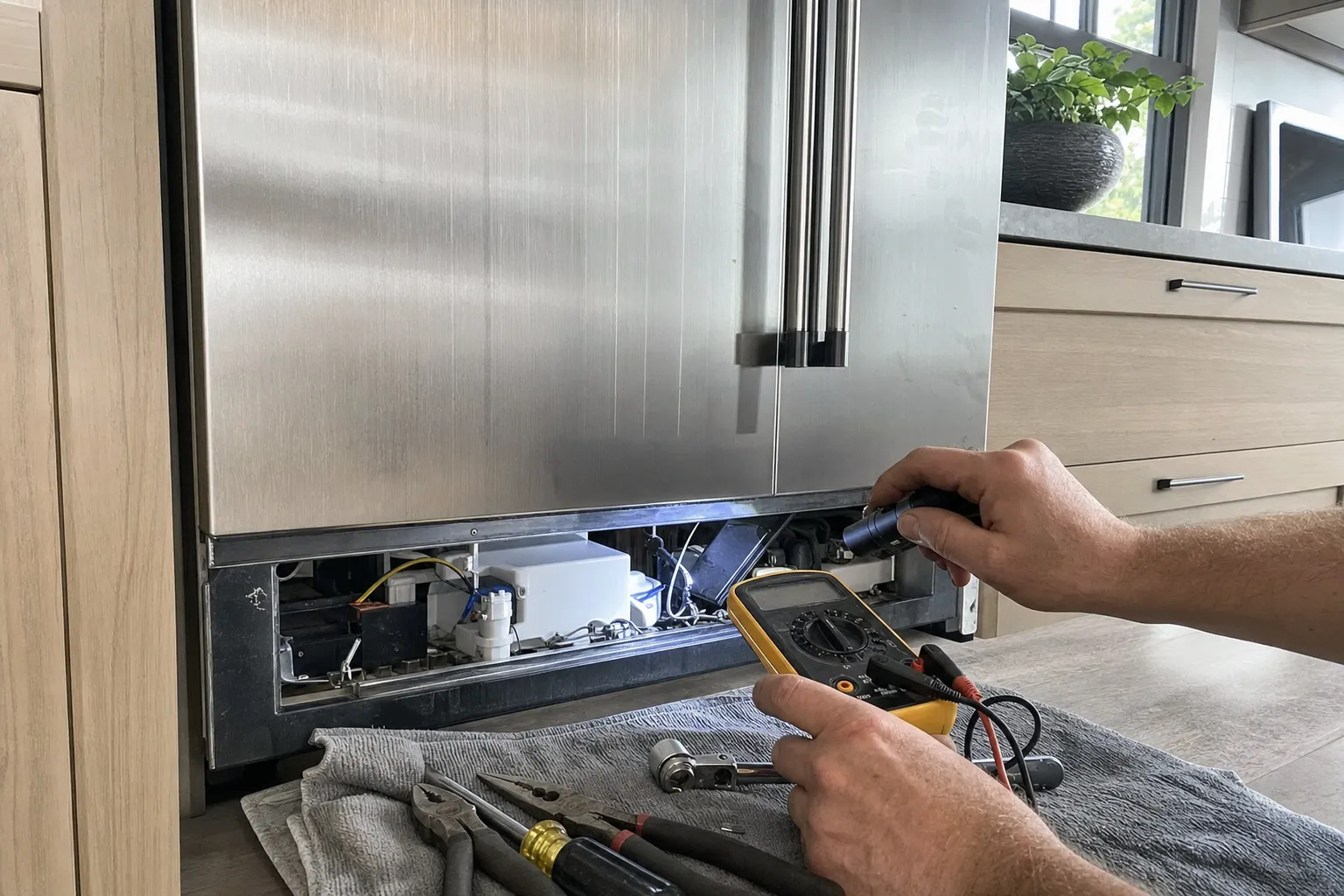
If the wrench icon on your Sub-Zero is blinking and the alarm is chiming, the control has stored a major fault code. A wrench that stays lit without blinking, still with the chime, marks a minor fault that is not yet putting your food temperatures at risk. That wrench belongs to Legacy Classic (BI) built-ins. On its own it is only a flag, so the useful next move is to find the code that travels with it, check both compartment temperatures, and work out whether you are facing a ten-minute cleaning job or a repair.
Blinking or steady: two different messages
Sub-Zero gave the wrench two meanings on Classic (BI) models. Blinking plus the chime is the serious one, a logged fault of the kind that can let a compartment warm up if nobody responds. Steady plus the chime is the milder version: the control spotted something unusual but does not judge your temperatures to be in danger.
Before you press a single key, record what the display shows. Owners often silence the chime first and then cannot remember which side was complaining. Note both temperatures, any letters or numbers beside them, and whether another icon is blinking too. A quick phone photo of the panel does the job and is the most useful thing you can hand a technician later.
On 600 and 700 Series units there is no wrench. Those panels flash the word Service between the zone temperatures instead, and the faults behind it belong to the same family described below.
Codes that tend to appear alongside the wrench
| What the display shows | What it points to | First move |
|---|---|---|
| EE on the left, wrench or Service blinking | Freezer temperature sensor (thermistor) has failed | Call for service |
| EE on the right, wrench or Service blinking | Refrigerator thermistor has failed | Call for service |
| EC50 with Service | Refrigerator compressor running far too long | Clean the condenser, then reset |
| EC40 with Service | Freezer compressor overrunning | Depends on how warm it is |
| Vacuum Condenser | Unit working too hard or running warm | Clean the condenser |
| One ice cube blinking, no chime | Ice maker valve stayed open too long | Check the water supply |
EE is the plainest of these. One of the temperature sensors is no longer sending a believable reading, and Sub-Zero offers owners nothing to try for it: no reset sequence and no cleaning step will bring a dead thermistor back. The compartment it watches cannot be regulated properly until the part is replaced.
EC40 deserves a closer look because it has several possible sources. On 600, 648PRO and 700 Series units it can mean the freezer compressor has been overrunning, a door was left ajar, or there is trouble with the sealed system, a fan or a temperature sensor.
What an owner can safely try first
Clean the condenser coil
Nearly every overrun code starts with a dusty condenser, so begin there. Kill power at the breaker, lift off the grille, and run a vacuum’s brush tool over the coil in the same direction the fins run so you do not fold them over. In Bridle Trails, where plenty of properties still keep horses, barn dust and hair can coat a coil quicker than owners expect. A flashing Vacuum Condenser message is the unit asking for exactly this job; once the coil is clean, switch the unit back on and the message resets.
Clear EC50 when temperatures are close to normal
With EC50 showing and both sides near their settings, clean the coil first, then keep a finger on the bell symbol, the key that normally warns about an open door, for a full 15 seconds. The code should drop off. If the fresh-food compartment is clearly warm, skip the reset and book a visit.
Use the 10-degree line for EC40
If the freezer sits less than 10° above its setting, clean the coil and keep an eye on it. If it reads more than 10° above and no door was propped open, a technician needs to look. Never clear EC40 while the reading keeps climbing, because that stored code is part of the record a technician uses to trace what went wrong.
Reset a lone Service message
When Service blinks with no code and the temperatures look about right, clean the condenser and then switch the home breaker off for 30 seconds to reset the control.
Restore a disabled ice maker
On a Classic (BI), one blinking ice cube with no chime is the control reporting that the fill valve was open for longer than it should have been; it turned ice production off on purpose to keep water out of the bin and off your floor. Make sure the shutoff behind the unit is fully open and the supply line has no kink, then hold the Alarm key until CFC, short for Clear Fault Codes, appears. Bellevue draws its tap water from the Cedar and Tolt river supplies, which are soft, so mineral scale is rarely what blocks a fill; look first for a line pinched behind the cabinetry.
Quiet the chime while you wait
To stop the chiming on a Classic (BI), press and hold ALARM and POWER together and let go of both in less than 5 seconds. That hides the indicator for 24 hours. It repairs nothing, and the fault is still sitting in memory.
When the wrench means book a technician
Some situations are past what a homeowner should chase:
- Any EE code, on either side of the display.
- EC40 or EC50 with a compartment noticeably warmer than its setting.
- A code that returns within a day or two of cleaning the coil and clearing it.
- A blinking wrench that comes straight back after a breaker reset.
- The compressor running nonstop while the fans stay silent, or frost building across the back wall.
For EE, the fix is normally the sensor itself, which sits in the defrost heater, thermostat or sensor band of $280–$670. Overrun codes that outlast a clean coil can trace to an evaporator or condenser fan motor ($330–$750), a tired door gasket ($280–$670), an electronic control board ($400–$910) or, at the far end, the sealed system ($1,400–$3,060). Even that last figure is a small share of what a comparable new built-in costs, which is why a proper diagnosis comes before any talk of replacing the unit.
Not cooling, yet no wrench at all
Many people who search for the wrench are really asking why the refrigerator quit cooling. Two display states cause that with no fault involved. Sh r on a Classic (BI) means Showroom Mode, in which the lights and display work but the unit will not cool. To leave it, press Power to turn the unit off, hold a matching Warmer and Colder key pair, press Power again, then release all three keys. On current Classic and Designer models, a display frozen at 38° and 0° while nothing gets cold can also mean Showroom Mode, and Sub-Zero points those owners to its customer care line.
Two dashes where a temperature belongs mean that zone was switched off. Press Power to shut the unit down, then hold that zone’s Warmer key while pressing Power to bring it back.
Booking a visit in Bellevue
Every visit begins with the $89 service call, which covers the drive and a complete diagnosis, and the full $89 is taken off the repair once you give the go-ahead. Have your phone photo of the display ready, along with the temperatures you noted. We work in Downtown Bellevue towers, Crossroads, Somerset, Bridle Trails and the rest of our Bellevue coverage. If you are unsure which series you own, our guide to Sub-Zero series by door and panel type will help you tell before you call (425) 696-2636.
Asked after reading this
What is Sub-Zero service code EC50?
EC50 tells you the refrigerator compressor has been running much longer than it should. If the readings sit near where you set them, vacuum the condenser and then keep the bell-shaped key, the one tied to the open-door warning, pressed for 15 seconds so the code clears. A warm fresh-food side is a different story: leave the code in place and schedule service.
Why is my Sub-Zero not cooling when no wrench or code is showing?
The most common no-fault causes are Showroom Mode, a switched-off zone and a clogged condenser. Sh r on a Classic (BI) display means Showroom Mode, which stops cooling entirely; two dashes in place of a temperature mean that zone was disabled. If the display looks normal, clean the condenser and check the door seals before calling.
Can I keep using my Sub-Zero while the wrench is flashing?
Usually yes, for a short time, as long as both compartments are holding near their settings. Put a simple thermometer in each one and check it morning and evening. If the freezer climbs or the fresh-food side drifts well above normal, move the most perishable food elsewhere and arrange a visit rather than waiting it out.
How much does a Sub-Zero wrench or EE repair usually cost?
It starts with the $89 service call, and that $89 is credited back once you approve the repair. A failed temperature sensor typically falls in the $280–$670 band, a fan motor in $330–$750 and a control board in $400–$910. You get the firm price after the diagnosis, before any work begins.
Why did the lights inside my Sub-Zero go out?
On Classic (CL) and Designer (DET, DEC) units, a door or drawer left slightly open makes the control switch the lights off so they stop adding heat. Shut every door and drawer firmly and give it one hour. If the lights are still dark after that, it is worth a service call.