Refrigerator Repair
Getting a Sub-Zero Into a Downtown Bellevue Tower: Freight Elevators, Move Windows
In a Downtown Bellevue tower the building sets the date, not the technician: freight elevator, insurance certificate and move window all have to line up before a Sub-Zero column can leave its millwork. Most repairs, though, never need any of that.
Written by
Bjorn Aaltonen
Refrigeration technician — wine storage and dual zones · 15 years in the trade · EPA 608 certified
Treats a drifting wine zone as a question about air rather than about the compressor: damper travel first, then the fan, then the door. Logs a full day before condemning a control, because the fault is usually only present for part of it.
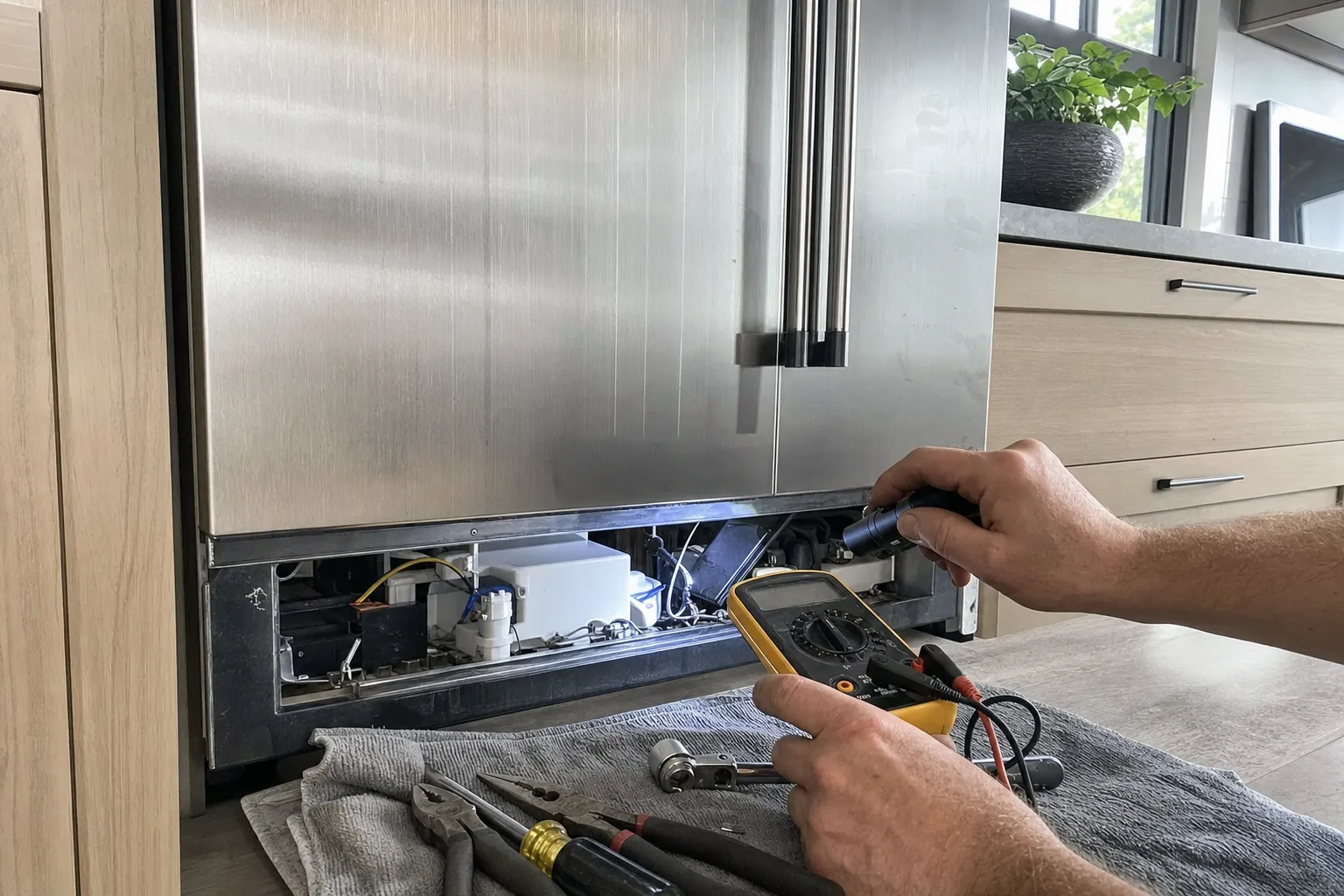
A Downtown Bellevue tower keeps a calendar of its own, and the appliance inside unit 2104 does not get a vote in it. Before anyone lifts a Sub-Zero column out of its opening in one of those buildings, three separate things have to line up: the freight elevator has to be free, the certificate of insurance has to name the building entity exactly as the management company words it, and the work has to fall inside the hours that building allows moves and deliveries. Miss one and the appliance stays exactly where it is for another week.
That is the real constraint on built-in refrigeration in a high-rise, and it is worth understanding before you are standing in a warm kitchen wondering why nobody can come out until Thursday.
What Bellevue actually does differently
Bellevue holds two completely different housing stories inside one city limit. Downtown is vertical — residences stacked above a commercial core, reached through a loading bay and a booked elevator. Crossroads is horizontal and older: largely low-rise apartment and townhouse stock built out around the shopping centre.
Those two ends of town produce opposite problems. In Crossroads there is usually no loading dock and no freight car at all, so the obstacle moves from the calendar to the doorway and the stair turn.
Bridle Trails and Somerset sit outside the argument entirely. On a wooded acre lot the van parks at the door, and the only gatekeeper is the width of a hallway.
How that reaches the appliance
An integrated column is not a movable object in the way a plug-in unit is. It is scribed into millwork, carrying a custom panel, sitting on levelled feet against a finished floor, plumbed to a water line that disappears somewhere into the cabinet base. Taking one out is joinery before it is refrigeration.
In Downtown Bellevue that means the removal itself is the scheduled event, not the repair. Anything that can be done with the unit still in its opening — sealed-system readings, control diagnostics, fan and defrost testing, gasket work, evaporator access from the front — happens on an ordinary service call with no building paperwork at all. Anything that needs the cabinet to come forward gets planned around whatever window the building will give.
The Crossroads pattern is different again. Built-in refrigeration in that older apartment stock is nearly always a retrofit into a room nobody drew for it. A full-height column ends up in an opening first sized for a freestanding unit, and the condenser is asked to breathe inside a run of cabinetry that was never given a grille.
What tends to give first
Heat rejection fails before anything electronic does. On a Designer column the waste heat leaves through a condenser behind the kickplate at floor level, and it needs a clear path in and a clear path out. Close that path — with a filler panel, a decorative grille with too little open area, or years of dust on the fins — and the compressor simply runs longer and longer for the same result.
That is what most of our early calls actually are. Milk spoiling early while the display still reads 38°F. A unit that runs without stopping and a floor in front of it that feels warm underfoot. Condensation beading along the inside of the door frame. A butter shelf gone soft while lettuce at the back of the same shelf has frozen solid, which is an airflow distribution symptom rather than a thermostat one.
Somerset adds a load of its own. Hillside houses there tend to have west-facing kitchens, and an afternoon of direct solar gain through glass puts the room well above the temperature the cabinet was rated in. The unit is not faulty; it is being asked to work in a hotter room than its spec sheet assumed, and it will show that between three and seven in the evening and look perfectly healthy the next morning.
What you can check yourself
Start with the grille, and start with the power. Sub-Zero prints two cautions beside this job: switch the power off at the control panel first, and wear gloves, because the condenser fins are sharp. Then pull the grille your model uses, look at the fins, and brush and vacuum along them rather than across them. If they are matted grey, you have found at least part of your answer.
Then test the door as we would. Take a slip of paper, shut the door on it at six points round the frame in turn, and tug. Wherever it comes away without resistance, the gasket is not sealing at that point. If a corner of the gasket has taken a permanent set and stands proud of the frame, room air is being drawn in continuously and the defrost system is fighting moisture it was never meant to see.
Last, look at what surrounds the cabinet. A pantry cupboard butted tight against the hinge side, a new panel added during a remodel, a laundry appliance venting into the same alcove — all of these change the air the condenser gets, and none of them look like faults.
What a visit settles
A diagnostic visit costs $89 and produces two things: what has actually failed, and whether the building has to be involved. Most of the time it does not. A defrost heater or sensor, a fan motor, a door gasket and a control board each sit in their own price band, printed on the repair pages. Sealed-system and compressor work sits in the highest band, and that is the one conversation where a tower’s move window genuinely bites, because the cabinet has to come out to do it properly.
If you live in a Downtown Bellevue building, tell us the management company’s name when you book. The insurance certificate and the elevator reservation get requested at the same time as the appointment, so the two calendars are already aligned before anyone arrives. (425) 696-2636 reaches the same technician who would take the call.
Asked after reading this
Do I need to book the freight elevator before a Sub-Zero repair in a Downtown Bellevue high-rise?
Only if the cabinet has to come out of its opening. Most diagnostics, and a good share of repairs, happen with the unit still in place and need no building involvement at all. Tell us the management company when you book and the insurance certificate and an elevator slot get requested in parallel, so paperwork is not what holds up the work.
Why does my built-in in Crossroads run constantly when my old one never did?
Built-in refrigeration in Crossroads apartment stock is nearly always a retrofit into a kitchen drawn for a freestanding unit, so the condenser often has to breathe inside cabinetry that was never given a grille. That single detail lengthens run time far more than age does. An $89 visit measures airflow and real shelf temperatures before anyone discusses parts.
The display says 38°F but food is spoiling. Is the sensor lying?
Sometimes, but airflow comes first. The display reports the control's sensor, not the shelf your milk is on, and blocked return-air vents or a seal that has taken a set will leave warm pockets while the sensor happily sees its target. We log actual temperatures at several points before replacing anything, and the range for a sensor or thermostat is printed on the refrigerator repair page.